Pages

Wednesday, February 2, 2011

Book Review: Histories and Fallacies


Over the past year, I have become increasingly aware of and interested in the need to exercise discernment in the arena of history studies. (This is largely due to following Simonetta Carr's blog which chronicles "The making of Christian biographies for young readers." It has been a lot of fun to "watch" her piece together the truth of history. I am grateful for her willingness to share her journey and for the example that she sets.)  As a result, I was excited to learn that I would have the opportunity to review Histories and Fallacies: The Problems Faced in the Writing of History by Carl R. Trueman.  I must confess at the outset of this review that I am incredibly "out of my league" with this particular title. I realized very quickly that my vocabulary is extremely narrow and that I am woefully lacking in my knowledge of basic history (and current events pertaining to said history). However, in spite of my limitations, I was able to glean a good deal from this book.

The Introduction serves as a road map of sorts ad is a very good one at that. In Chapter 1, Trueman discusses the difference between  neutrality and objectivity. While no historian will be neutral in his/her retelling of the past, there will be verifiable facts, evidence, etc. by which one may ascertain what actually occurred. Trueman walks through some of the claims of those who deny the Holocaust in order to bring to light some of the basic strategies of good (and bad) historical method.

Trueman then moves to a discussion of interpretive frameworks in Chapter 2. Call it what you will: worldview, presuppositions, ideological commitments, beliefs; we all have them, and they drastically influence how we interpret the truth, including the truth about the past. Truman chooses to demonstrate the strengths and limitations of  interpretive schemes by evaluating Marxism.

Chapter 3 addresses the problem of anachronism. This was a new term for me and really made me feel like I was back in college with a bunch of intellectuals...and a bit out of my league. However, anachronism isn't nearly as complex as it sounds; it merely refers to the fact that the historian is in the present while addressing questions to the past. This time gap creates a whole host of problems similar to a tourist visiting a foreign country. Trueman highlights many of these problems and says, "Simply to be aware of the potential problem is a crucial move toward avoiding it" (pg. 115). This chapter, like the ones that go before it, is full of helpful reminders including the need to be modest in the conclusions one draws (pg. 140).

Finally, Chapter 4 is a treatment of various issues to which historians can be prone and of which they ought to be aware (oversimplification, generalization, poor framing of questions, etc.). Once again, Trueman makes statements that are pertinent to all of life. Fox example, he spends time relaying the importance of asking the right questions.

"...the framing of a question can shape the answer" (pg 162).
 "...often, questions are clearly driven by particular ideological commitments that arguably lead to distorted answers" (pg. 163).

In layman's terms, we tend to ask loaded questions.

Mr. Trueman rightfully acknowledges that he has "barely scratched the surface of what it means to write history" (pg. 169). While I would have liked to have seen greater depth in certain aspects, especially with regard to how a Biblical worldview affects ones' study of history (as opposed to merely focusing on Marxism), I believe Mr. Trueman gives his reader a great start. In my case, he has successfully fulfilled his objective "to ignite that interest [in understanding the past] in others, to guide them away from dead ends and methodological mistakes to fruitful and creative avenues of approach, and to help in some small way the next generation of those who wish to make history come alive for future generations" (pg 181).

In conclusion, Histories and Fallacies is a book I would loved to have understood before or during my college years. However, I am grateful for the opportunity to read and process the material now and look forward to using the knowledge that I have gleaned to be a more discerning reader across multiple disciplines. I trust many others will greatly benefit from it as well.

*Many thanks to Crossway for sending me a copy of this book in exchange for my honest opinion!

Monday, January 10, 2011

Preschool Devotional Resources

Are you looking for some resources to help your family get into the habit of sharing a regular devotion time together? If so, you may be interested in looking at these books published by The Good Book Company.


Beginning with God: Book 1This is a very basic book designed to be used with The Beginner's Bible or a similar children's Bible. It is a simple tool to guide parents in regular Bible time with preschoolers. It contains key Biblical truths to read and discuss with young children. It also has prayer points at the beginning and end of each lesson to help you and your child cultivate the discipline of prayer. There are activity suggestions to help the parent/teacher make the lesson more memorable and to help continue the conversation beyond the formal reading time. My kids are constantly bringing this book to me and asking me to read them another passage because they like placing the sticker (included with the book) on the page once the lesson has been read.


Like Beginning with God, this resource is designed to be used with The Beginner's Bible and  includes prayer points at the beginning and end of lessons, Biblical truths to read, and discussion questions from the story. Each lesson also has a sticker and coloring page. It's not too late to reflect on the true meaning of Christmas with a resource like this!

These two are very basic for pre-schoolers containing the overall content of the Bible stories. I would recommend using these with The Jesus Storybook Bible or The Big Picture Story Bible so as to help the little ones see the Gospel in all of the Bible. The greatest asset of these guides (in my opinion) are they prayer points and activity suggestions. I think they would be especially helpful to those who aren't comfortable doing this type of thing with their child.

Personally, I would like to have seen more reference to the Gospel in these books.  However, they do state the truth about Christ's Lordship clearly. Check out the book samples at the links above and see if these might be a good fit for your family!

*Many thanks to The Good Book Company for sending me these books in exchange for my honest opinion!
Wednesday, January 5, 2011

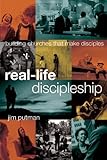
Book Review: real-life discipleship


Putnam’s major presupposition in real-life discipleship is that there are five stages that comprise the spiritual growth process (spiritually dead, spiritual infant, spiritual child, spiritual young adult, spiritual parents). He outlines characteristics of each of his stages, as well as, ways to recognize which stage people are in and what people in each stage need to know. Putman lists topics one might cover with a disciple as well as recommended reading but never specifically discusses how to practically utilize either. The curriculum detailed in the book is the use of Bible storying in a small group context.

Putman rightly recognizes: that spiritual growth is a process; that we have to look at the heart motivations behind people's actions; and that humility is one of the most important character traits of a mature believer and leader. However, there are parts of the book which could be strengthened.  Although, sharing the gospel was mentioned, it was not expounded upon where it should have been primary. For example, Chapter Seven, "Moving the Spiritually Dead Toward Life", was particularly disappointing and weak. It spoke more about sharing your testimony and answering an unbeliever's questions than about sharing the gospel. Furthermore, certain aspects of this book (such as the spiritual growth process noted above) needed to be better grounded in Scripture.

Also noteworthy is that real-life discipleship contains no gender distinctions. While our knowledge of God in the discipleship process will be similar, application of that knowledge will often differ. Since Putnam defines a disciple as: "...one who is following Christ (head), being changed by Christ (heart), and committed to the mission of Christ (hands)" (pg. 29-32), I would expect some treatment of varying roles would be appropriate.

All-in-all, I think that there are beneficial things to be gleaned from real-life discipleship, as well as, some food-for-thought. However, it is not the only book one will want to read on the subject and seems geared more towards church leaders.

*Disclosure of Material Connection: I received this book free from NavPress Publishers as part of their Blogger Review Program. I was not required to write a positive review. The opinions I have expressed are my own. I am disclosing this in accordance with the Federal Trade Commision's 16 CFR, Part 255: "Guides Concerning the Use of Endorsements and Testimonials in Advertising."